Beekeeping Calendar 2026 + Varroa Treatment Checklist — Two Free Printables Every Beekeeper Needs
Why Every Apiary Needs a Plan on Paper
Ask any beekeeper with twenty years of experience what separates a good season from a disastrous one, and you will rarely hear "luck". You will hear about timing. The swarm that left because queen cells were checked a week too late. The colony that starved in February because stores were never hefted. The winter bees that hatched full of viruses because the August Varroa treatment was guessed rather than measured.
Beekeeping is a chain of small, time-sensitive decisions. Each decision looks trivial in isolation — open or not open, feed or not feed, treat now or next week. But the bees' biological clock doesn't pause while we hesitate. Brood restarts in February whether or not you have stores. Queen cells get capped whether or not you find them. Winter bees are produced in August whether or not the mites are under control. The beekeeper who knows what is due this month — and has a simple way to record what actually happened — consistently outperforms the one working from memory.
That is exactly the problem we designed two new printable documents to solve. The Beekeeping Calendar 2026 tells you what the colony is doing each month and what you should be doing about it. The Varroa Treatment Checklist turns the single most important — and most frequently botched — management task into a disciplined, label-first, paper workflow. Both are free downloads for registered users of Beekeeping Diary, available in English and Bulgarian, and this article walks you through exactly what is inside them, how they are built, and how to combine them with the app for a complete paper-plus-digital system.
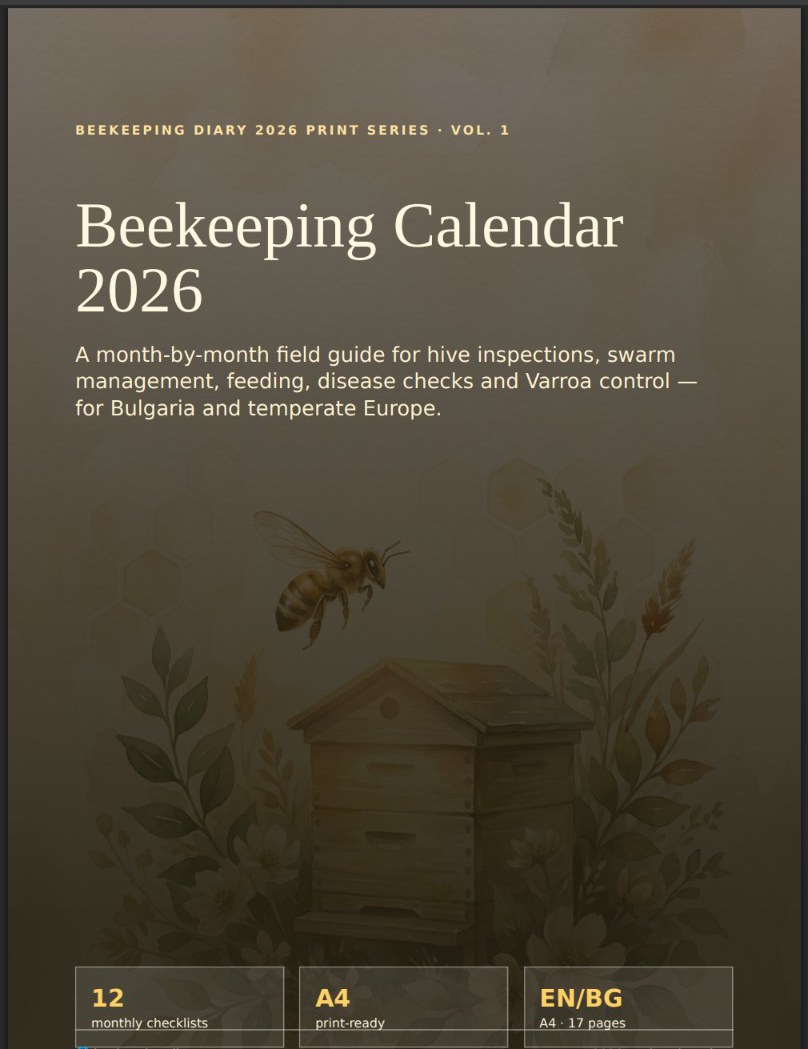
What You Get: Two Documents, One System
These are two volumes of the Beekeeping Diary 2026 Print Series, and they are deliberately designed as companions rather than standalone books:
- Volume 1 — Beekeeping Calendar 2026: 17 A4 pages, print-ready. One checklist page per month (12 in total), plus a how-to-use guide, an annual rhythm overview, a Varroa & disease reminders page, and a sources page. Written for Bulgaria and temperate Europe, in both English and Bulgarian.
- Volume 2 — Varroa Treatment Checklist: 8 printable form pages. A fill-in worksheet that carries you through the entire IPM cycle: monitor → decide → apply → verify, with a strong "label-first" safety layer.
The division of labor is simple. The calendar answers "when and why" — when to check for queen cells, when to stop opening, when to start winter feeding. The checklist answers "how, exactly" — which monitoring method you used, what the label of your chosen product actually says, when the strips went in and when they must come out, and whether the treatment actually worked.
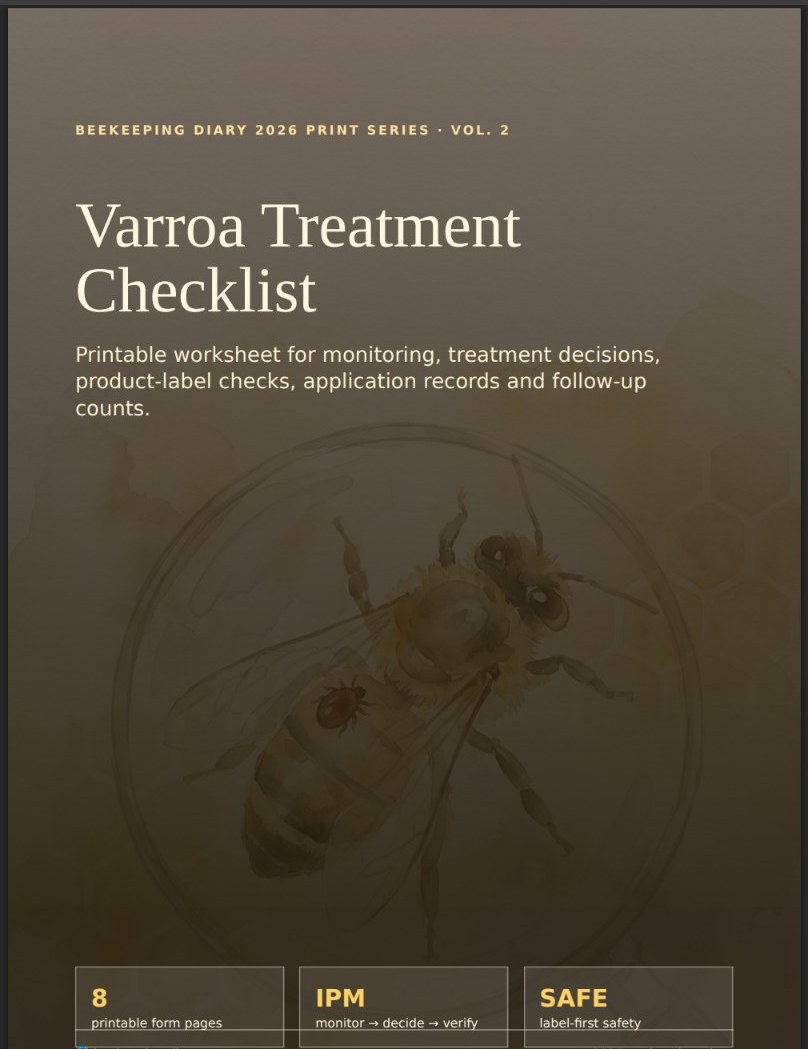
Both documents share the same philosophy that runs through everything we build at Beekeeping Diary: decisions from evidence, never from habit. Treat Varroa from measurements and labels, not because "it's what I always do in August". Open a hive because the weather and the task justify the disturbance, not because a date on a wall chart says so. Write numbers — hive weight, mites per 100 bees, frames of brood — not impressions.

ApiaryPro Insulated Bee Hive — Winter-Safe Colony Housing
- ✅ Superior insulation keeps the winter cluster warm and dry
- ✅ Moisture control that protects stores all winter long
- ✅ Durable construction that seasons your apiary for years
Pair your winter preparation with a hive built for the cold months.
View on ApiaryPro →Inside the Beekeeping Calendar 2026
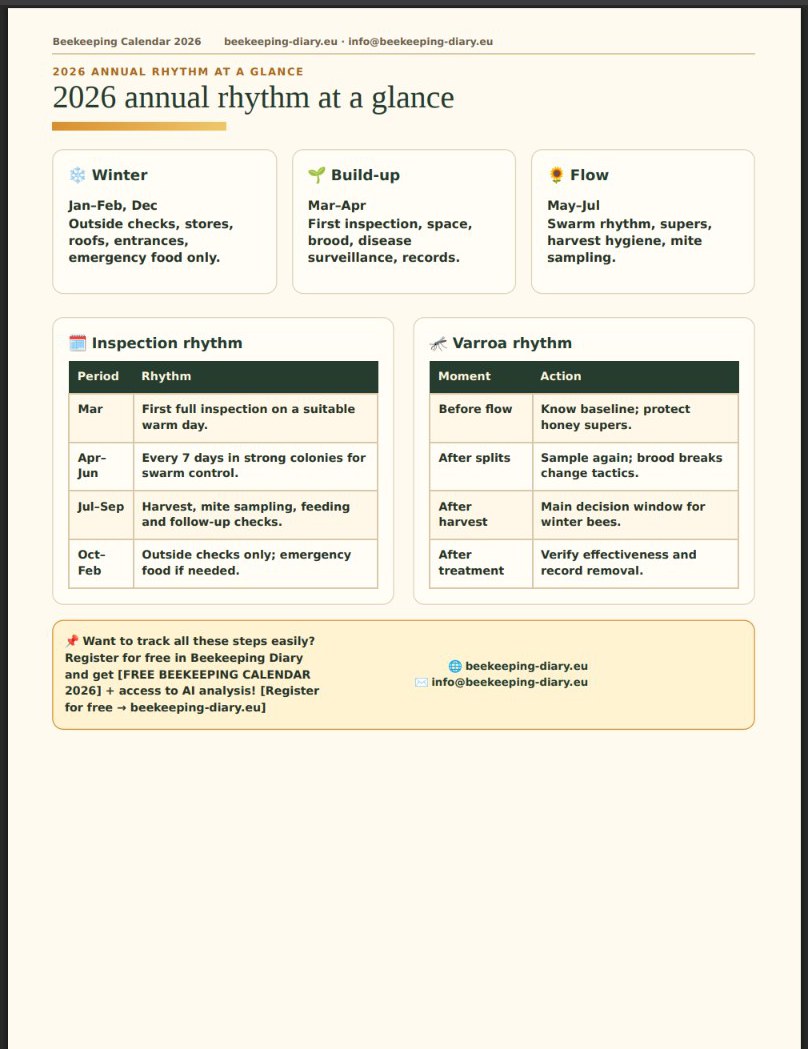
The calendar opens with a short, honest instruction page — "How to use this calendar" — and its first rule is the most important one in the entire document: local first. Every window in the calendar should be shifted by up to ±2 weeks depending on your altitude, rainfall, bloom and colony strength. A calendar that pretends March 15th means the same thing in the Thracian plain and a 1,200 m mountain apiary would be worse than useless. This one explicitly tells you to treat the dates as rhythm, not law.
Four more working principles follow, and they tell you a lot about the spirit of the document:
- Open only when justified. Never chill brood just because the calendar says "March". If the day isn't warm enough, the task can wait — the colony pays for every unnecessary disturbance.
- Pencil in the apiary, then copy online. The printed calendar is a field tool; the final data belongs in your Beekeeping Diary account, where it becomes searchable history and feeds AI analysis.
- Treat Varroa from measurements and labels, not habit. The calendar never tells you which product to use — it tells you when to measure and how to decide.
- Record surprises. Queen events, robbing, starvation risk, disease signs, pesticide exposure. The unexpected observations are the ones you'll search for next year.
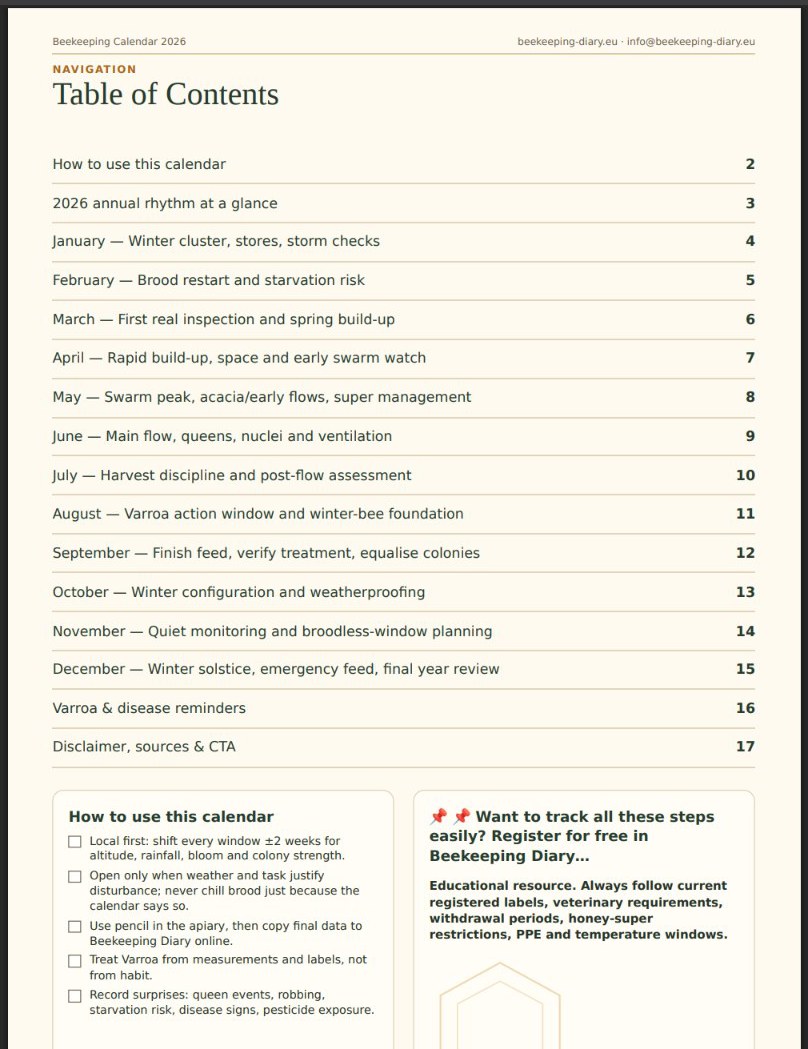
Page 3 gives you the 2026 annual rhythm at a glance — a single-page map of the whole year compressed into four seasons and two rhythm tables. The inspection rhythm table is worth memorizing: first full inspection in March on a suitable warm day, then every 7 days in strong colonies from April to June for swarm control, harvest and mite sampling from July to September, and outside checks only from October to February. Alongside it sits a Varroa rhythm table with four decision moments: before the flow (know your baseline), after splits (sample again — brood breaks change tactics), after harvest (the main decision window), and after treatment (verify effectiveness and record removal).
We won't reproduce all twelve monthly pages here — that would defeat the purpose of the download — but here is a preview of the kind of guidance you'll find, and why it earns its place on your clipboard.
The Anatomy of a Monthly Checklist
Every month page follows the same four-block structure, which takes about ten seconds to scan at the hive:
- Focus — one or two sentences defining the single most important priority of the month. January: "The colony should be quiet and compact. Your job is to protect heat, food and entrances — not to inspect frames." It's remarkable how much bad beekeeping this one line prevents.
- Inside the hive this month — a short biology briefing of what the colony is actually doing, with concrete numbers. This is the block that turns the calendar from a task list into an education.
- Field checklist — 8–10 concrete, checkable actions, each phrased as an instruction rather than a vague reminder.
- A log row — date, weather, colonies visited, Varroa/feed note, and a free notes column, so the page doubles as your inspection record for the month.
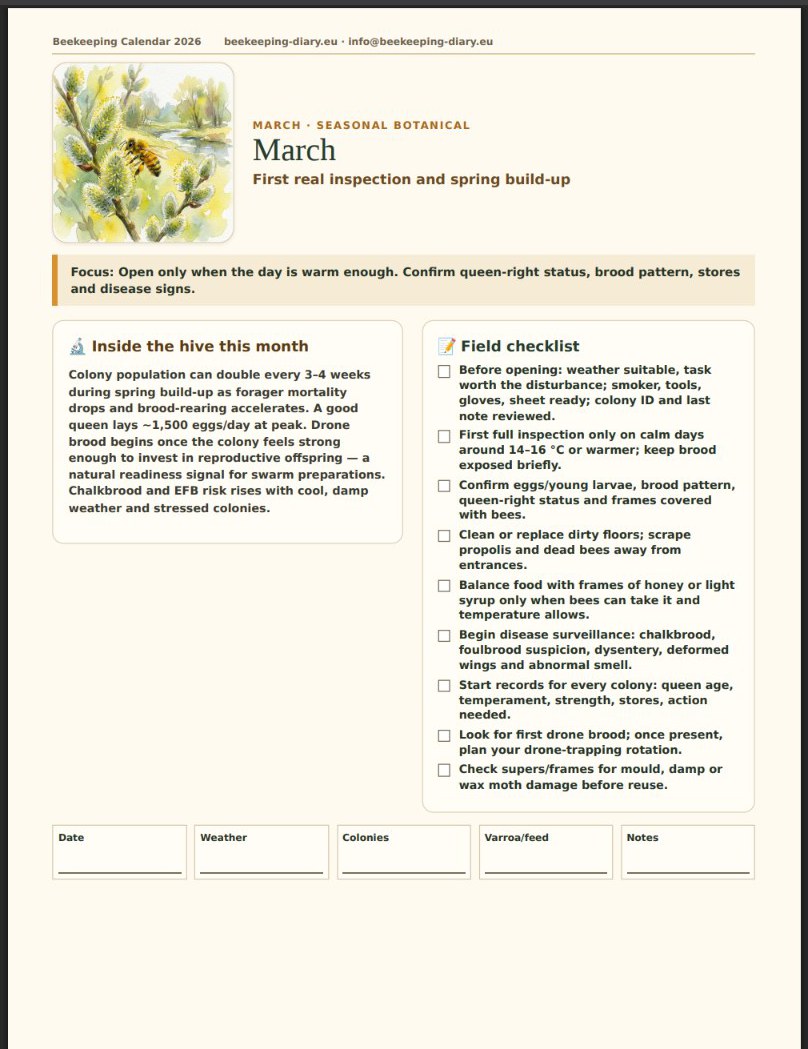
The March page is a good example. The focus: open only when the day is warm enough, then confirm queen-right status, brood pattern, stores and disease signs. The biology briefing tells you that a colony's population can double every 3–4 weeks in spring build-up, that a good queen lays about 1,500 eggs per day at peak, and that the first capped drone brood is a natural readiness signal for swarm preparations — which is why the checklist tells you to start planning your drone-trapping rotation the moment you see it. The field checklist then walks you through confirming eggs and young larvae, cleaning floors, starting per-colony records (queen age, temperament, strength, stores, action needed), and beginning disease surveillance: chalkbrood, foulbrood suspicion, dysentery, deformed wings.
A Season-by-Season Preview
Here is a taste of what the twelve monthly pages cover — enough to show you the depth, without giving away the whole download.
Winter (January, February, December)
Winter pages are deliberately restrained: the recurring message is that your main job is not opening the hive. Instead you learn to listen at the entrance (a steady low hum is normal; loud or splintered noise means a problem), heft the hive from the back to estimate stores without disturbing the cluster, keep entrances clear of snow and dead bees, and reserve emergency fondant — never liquid syrup in cold weather, because breaking the winter seal can chill brood. The biology briefings are quietly fascinating: the broodless cluster holds 12–15 °C at its core, winter bees live 4–6 times longer than summer bees thanks to enlarged fat bodies and high vitellogenin reserves, and CO₂ inside the cluster rises to 3–4 % — levels mammals would never tolerate.
February's warning is the one that saves colonies every year: the danger is starvation close to spring, not cold alone. Brood rearing restarts once the cluster core holds ~34 °C for several days, and food consumption climbs exactly when outside forage is still unavailable. Hence the checklist: briefly lift covers on a mild day only to confirm feed position — checks under one minute — and place fondant where the bees can reach it, directly above the cluster.
Build-up (March, April)
Spring is about space and discipline. April's page tells you that a colony with 6+ frames of brood is already approaching the swarming threshold — congestion triggers queen cells, usually on the bottom edges of frames — so the 7-day inspection rhythm starts now, before the brood nest is packed. Supers go on before the main flow, not after. Weak colonies get thin 1:1 syrup until they build up, and — a line we especially like — you note hive weight and stores weekly and "write numbers, not impressions".
Flow (May, June)
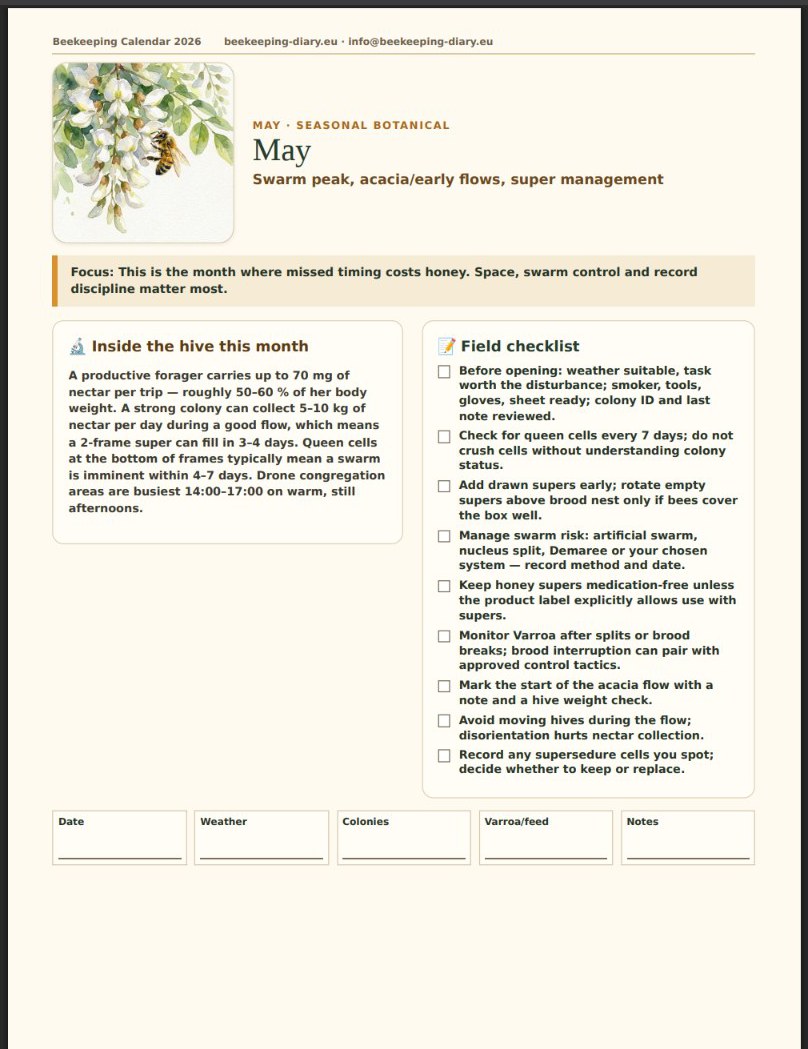
May's focus line is blunt: "This is the month where missed timing costs honey." The biology briefing quantifies the stakes — a productive forager carries up to 70 mg of nectar per trip (50–60 % of her body weight), and a strong colony can bring in 5–10 kg of nectar per day during a good flow, which means a super can fill in 3–4 days. Queen cells on the bottom edges of frames typically mean a swarm within 4–7 days. The checklist covers the full swarm-management toolkit — checking cells every 7 days, adding drawn supers early, choosing and recording your control method (artificial swarm, nucleus split, Demaree), protecting medication-free honey supers, and marking the start of the acacia flow with a note and a hive weight check.
June covers the main flow, queen rearing and nuclei — with practical cautions you don't often see in print: run a refractometer check on capped honey before extracting, because nectar above 18 % moisture risks fermentation while capped honey at 16–18 % is shelf-stable. Take a mid-season Varroa sample in production colonies, especially after brood breaks. And keep records of which colonies you breed from, because hygienic behavior — the uncapping and removal of diseased brood — is a heritable trait.
Harvest and the Varroa Window (July, August)
July is harvest discipline: extract only capped or refractometer-confirmed honey, sample Varroa as soon as the supers come off — "do not wait until September if levels are high" — and immediately assess the queen that must raise next month's winter bees. A failing queen in mid-summer is far worse than one in autumn, because supersedure cells may not save the colony in time for the winter-bee window.
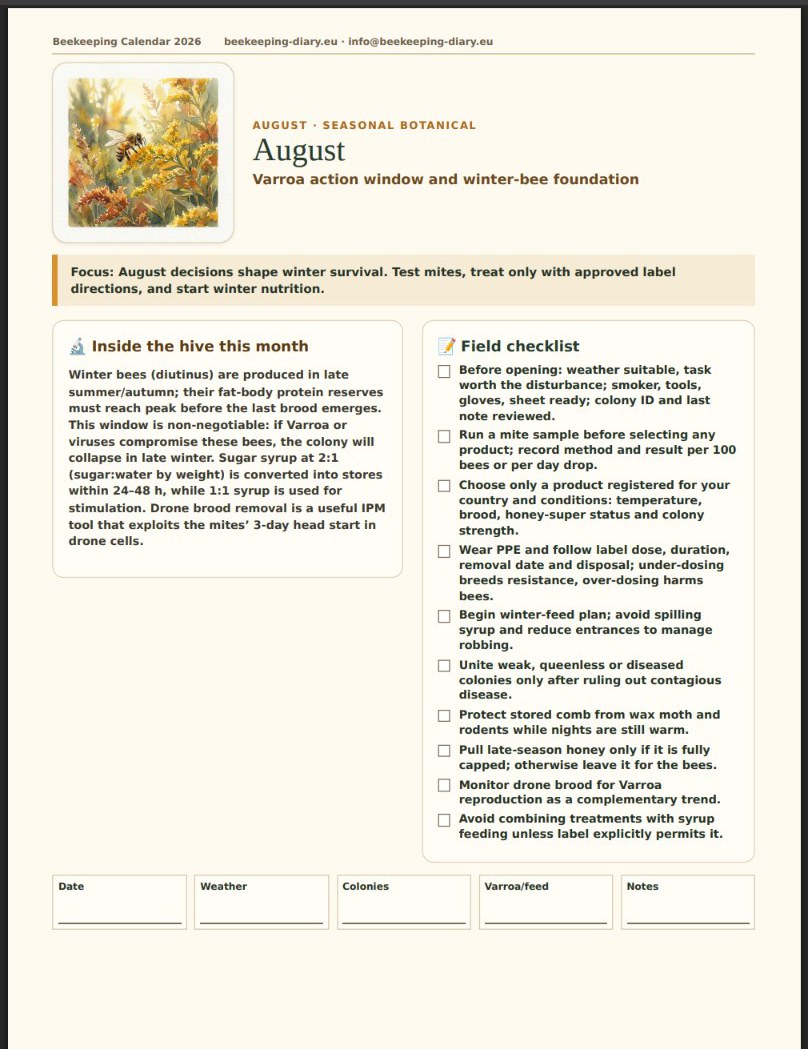
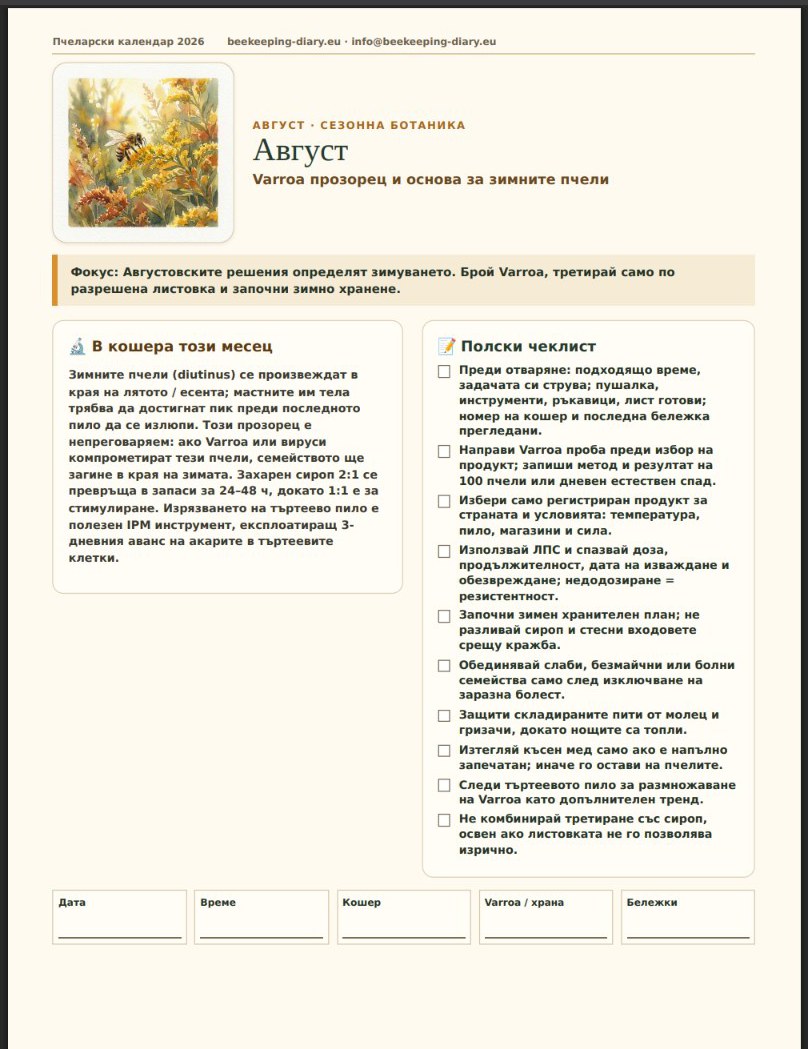
August is, without exaggeration, the most consequential page in the calendar. The briefing explains why: winter bees are produced in late summer and autumn, and their fat-body reserves must peak before the last brood emerges. This window is non-negotiable — if Varroa or viruses compromise these bees, the colony collapses in late winter no matter how much honey it has. The checklist runs a mite sample before any product selection, insists on a registered product matched to your actual conditions (temperature, brood, honey-super status, colony strength), demands exact label compliance on dose, duration, removal date and disposal — "under-dosing breeds resistance, over-dosing harms bees" — and starts the winter-feed plan. The practical nutrition detail is worth keeping: 2:1 syrup is converted into stores within 24–48 hours, while 1:1 is a stimulation mix.
Wintering (September, October, November, December)
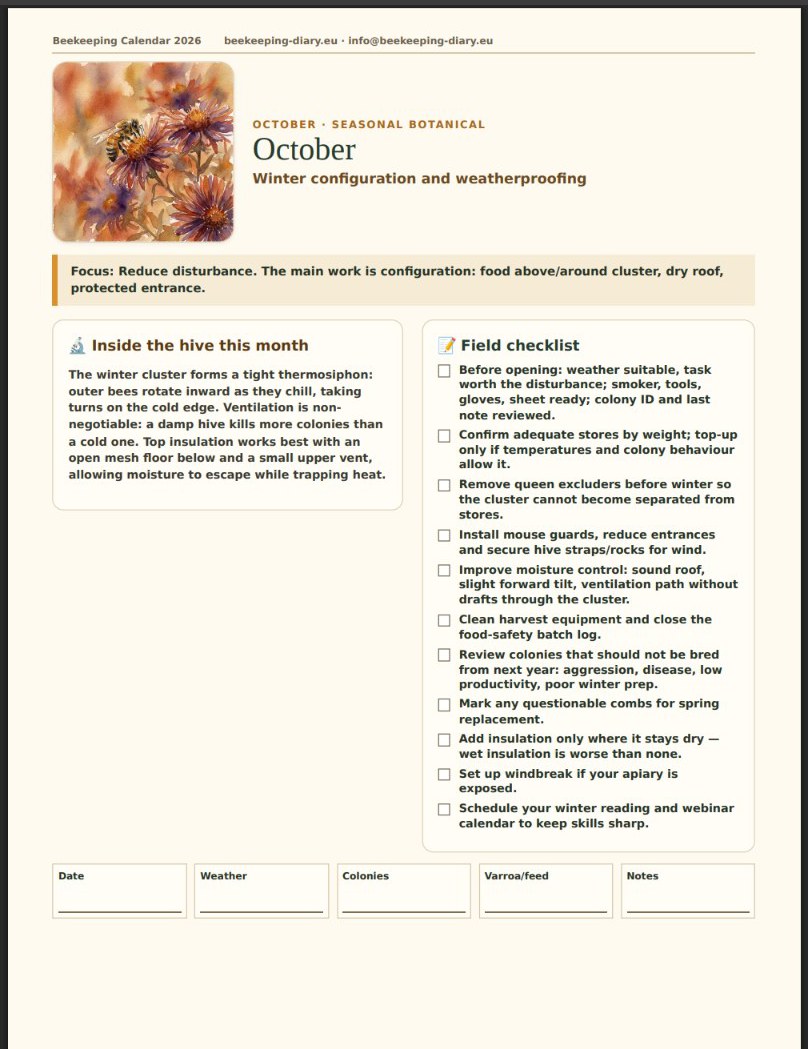
September finishes winter feeding early enough for bees to invert and cap the stores before sustained frost — uncapped late syrup can ferment and trigger dysentery — and reminds you that a medium colony of ~30,000 bees needs roughly 15–18 kg of stores to overwinter in a single brood box. October is configuration: food above and around the cluster, queen excluders removed before winter so the cluster cannot become separated from stores, mouse guards on, entrances reduced, and moisture control taken seriously — the page's most quotatable line is that "a damp hive kills more colonies than a cold one". The biology block explains the cluster's thermosiphon and why top insulation works best with an open mesh floor and a small upper vent: moisture escapes, heat stays.
November and December close the year with quiet monitoring, broodless-window planning, emergency fondant logistics, record audits and — the part most of us skip — an honest year-end economics review: honey kilograms, feed kilograms, treatment and queen costs, losses, and goals for 2027. December's briefing ends the loop beautifully: cluster core sits at 18–28 °C even below −15 °C outside, consumption falls to 0.3–0.5 kg per week at the solstice, and short cleansing flights on sunny, calm days above ~10 °C matter more than beekeepers realize.
The calendar closes with a one-page Varroa & disease reminders table (repeatable monitoring method, action thresholds around 2–3 mites per 100 bees, product choice matched to conditions, and the red flags that mean "stop and seek competent advice": sunken cappings, ropey larvae, bad smell, deformed wings, heavy dysentery) and a sources page citing Honey Bee Health Coalition, University of Minnesota Bee Lab, Cornell CALS, FAO TECA and Apimondia — so you can check every recommendation against its origin.
The Varroa Treatment Checklist — Your Weapon Against the Biggest Hive Killer
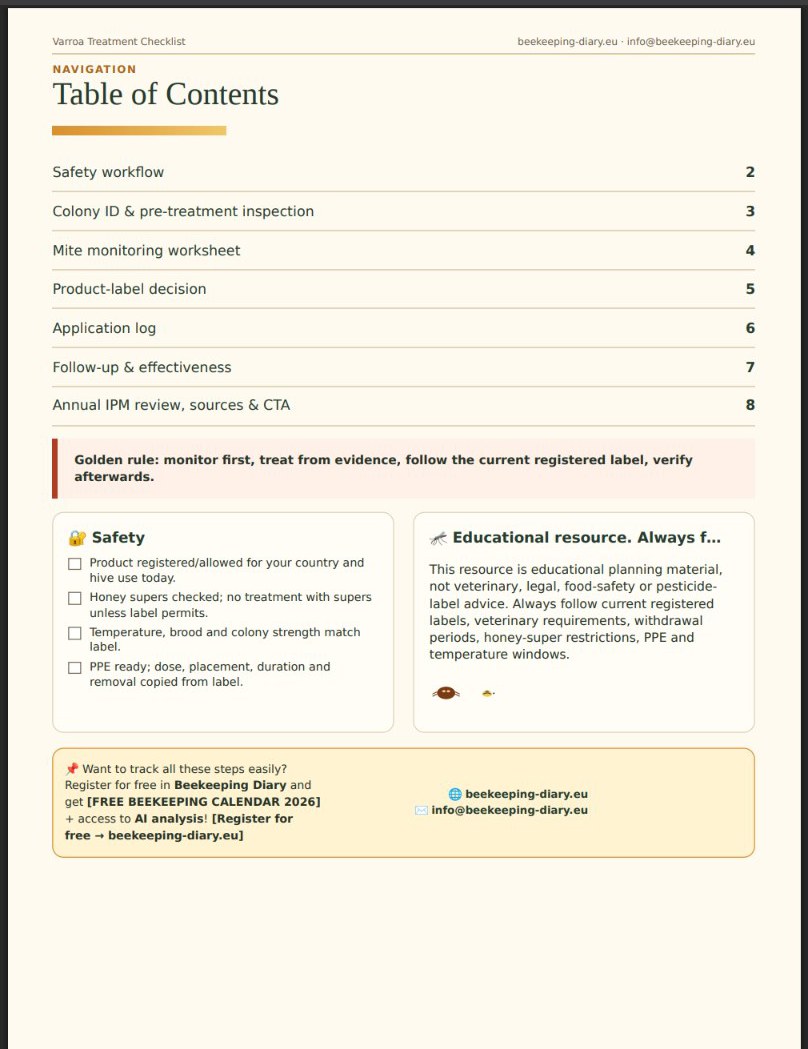
If the calendar is your rhythm section, the Varroa Treatment Checklist is your safety system. It exists because Varroa management fails in predictable ways: beekeepers treat by calendar habit instead of measurement, copy doses from forums instead of labels, leave strips in longer than permitted, never verify whether the treatment worked, and then repeat the same failed mode of action. The checklist's golden rule, printed on its first content page, is the antidote: monitor first, treat from evidence, follow the current registered label, verify afterwards.
The 8 pages are structured as five numbered steps wrapped in a safety workflow — IPM ("monitor → decide → verify") on one side, SAFE ("label-first safety") on the other. Every page repeats a four-point safety gate you tick before anything else:
- The product is registered/allowed for your country and hive use today.
- Honey supers are checked — no treatment with supers unless the label permits it.
- Temperature, brood and colony strength match the label.
- PPE is ready; dose, placement, duration and removal are copied from the label.
The Five Steps, One by One
Step 1 — Colony ID & Pre-Treatment Inspection
A form header that forces context before action: apiary, date, colony ID, queen year and color, weather, temperature. You can't treat what you haven't identified, and next winter you'll want to know which colony was treated with what and how it went.
Step 2 — Mite Monitoring Worksheet
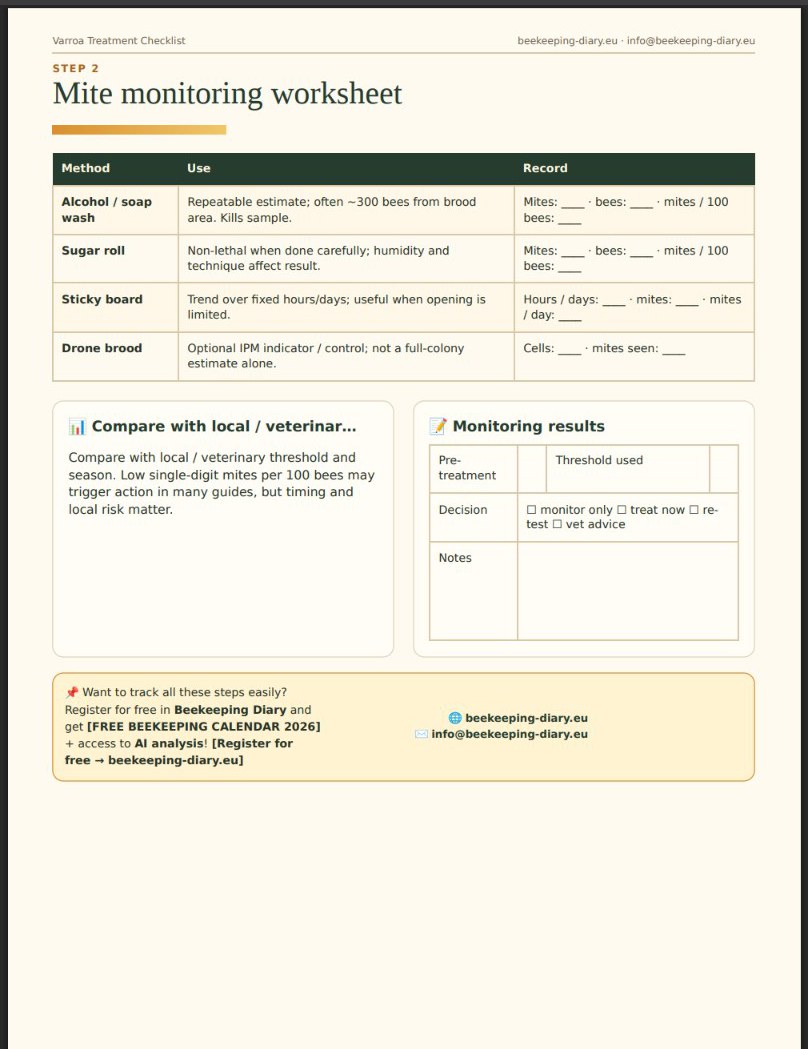
This is the heart of the document. Four methods are laid out with their trade-offs and dedicated result fields:
- Alcohol/soap wash — the repeatable estimate, typically ~300 bees from the brood area. Highest confidence; kills the sample.
- Sugar roll — non-lethal when done carefully; humidity and technique affect the result.
- Sticky board — a trend over fixed hours or days; useful when opening the hive is limited.
- Drone brood — a supplementary IPM indicator; not a full-colony estimate on its own.
Each method gets fields for mites counted, bees sampled and mites per 100 bees — so your numbers are comparable across colonies and seasons. The decision box then forces a structured choice: monitor only / treat now / re-test / veterinary advice, with the used threshold recorded. The worksheet's guidance notes that low single-digit mite counts per 100 bees may already trigger action in many guides — but timing and local risk decide.
Step 3 — Treatment Decision & Product-Label Check
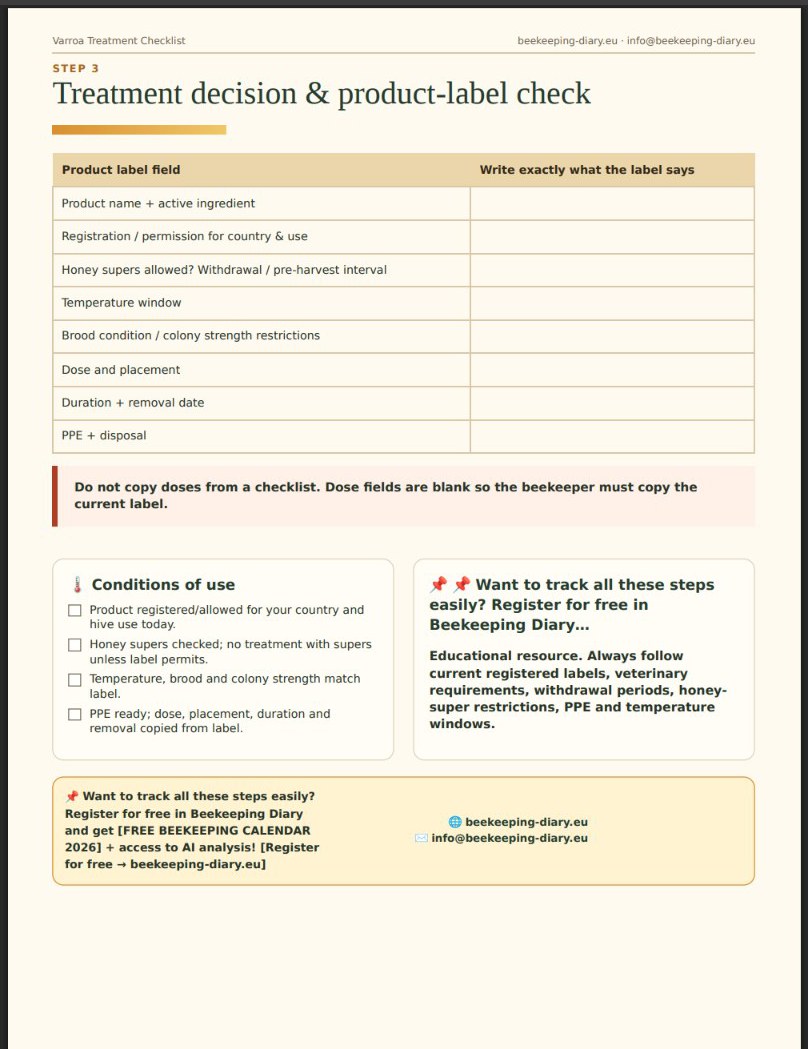
Here is the design decision that makes this checklist genuinely different: all dose fields are blank. The table's fields — product name and active ingredient, registration for your country, whether honey supers are allowed, withdrawal/pre-harvest interval, temperature window, brood and colony-strength restrictions, dose and placement, duration plus removal date, PPE and disposal — are there so you transcribe the current registered label word for word. The page says it explicitly: "Do not copy doses from a checklist. Dose fields are blank so the beekeeper must copy the current label." Products differ between countries, formulations change, and off-label use is both illegal and a resistance factory. This page turns label compliance from a chore into a checkbox.
Step 4 — Application Log
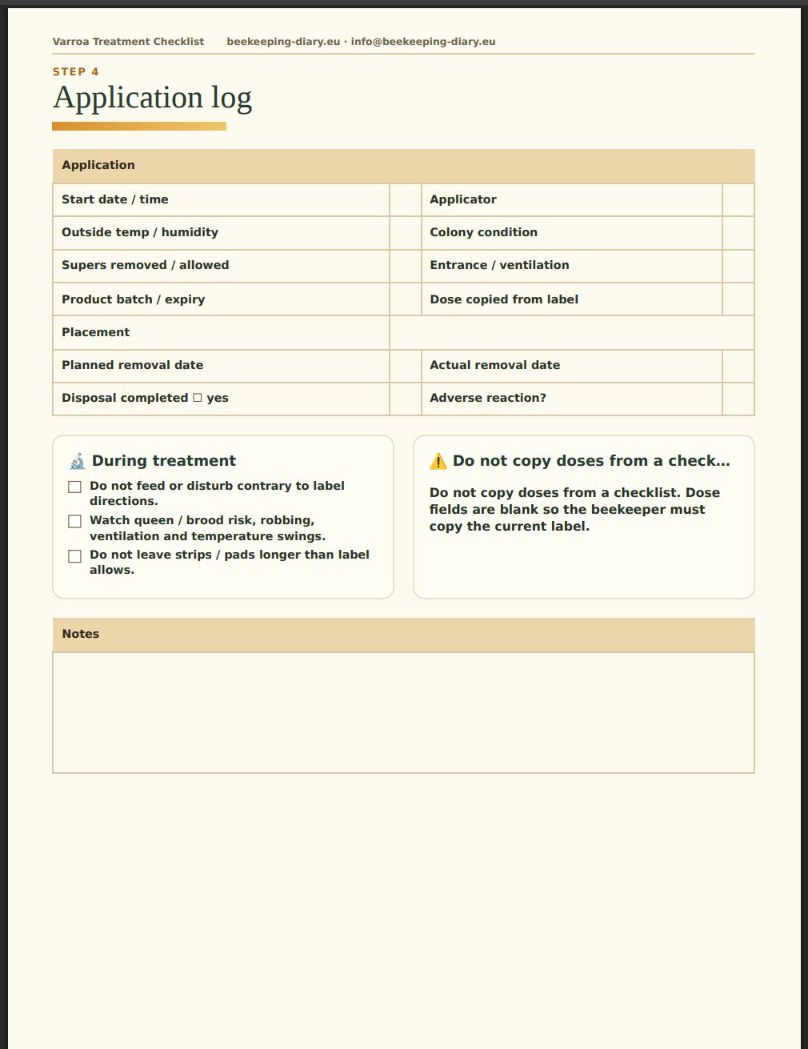
The treatment itself gets a proper record: start date and time, applicator, outside temperature and humidity, colony condition, super status, entrance/ventilation, product batch and expiry, dose as copied from the label, placement, and — critically — planned removal date next to actual removal date. During-treatment reminders keep you honest: don't feed or disturb contrary to label directions, watch for queen/brood risk, robbing, ventilation and temperature swings, and never leave strips or pads in longer than the label allows.
Step 5 — Follow-Up & Effectiveness
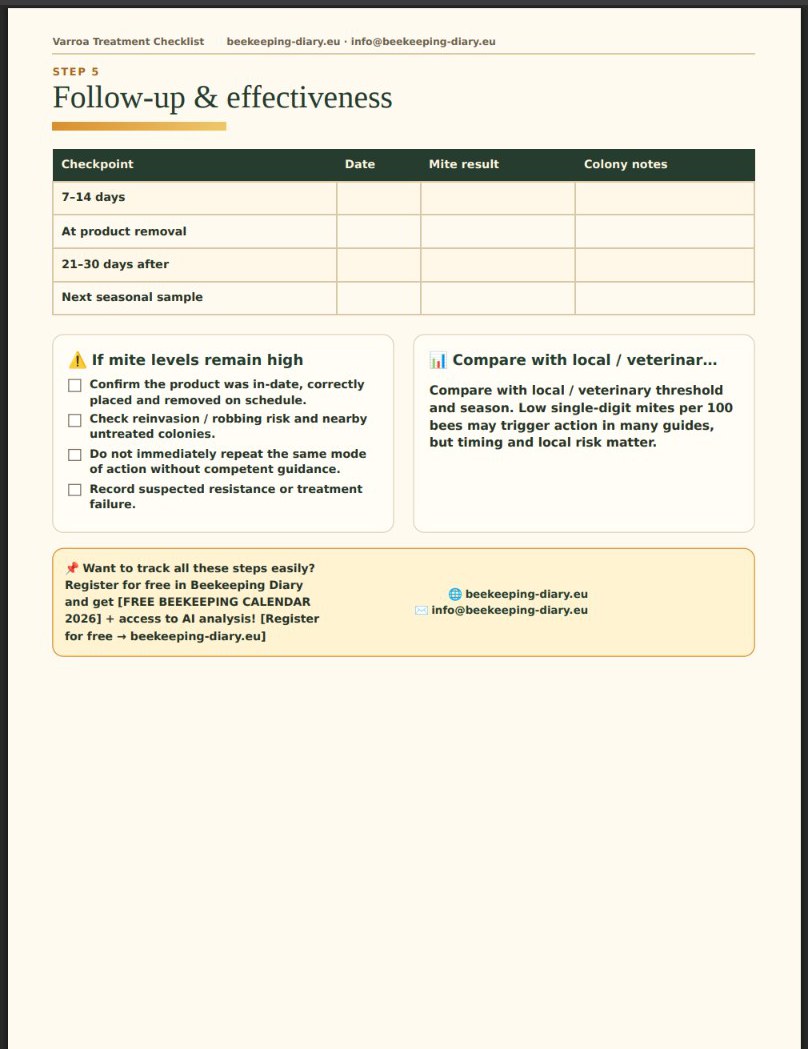
Four verification checkpoints with fields for date, mite result and colony notes: 7–14 days after application, at product removal, 21–30 days after, and the next seasonal sample. Then the page that would prevent most treatment failures if everyone read it — "If mite levels remain high": confirm the product was in-date, correctly placed and removed on schedule; check reinvasion from robbing and nearby untreated colonies; do not immediately repeat the same mode of action without competent guidance; and record suspected resistance or treatment failure. The final page is an annual IPM review — did you rotate products and modes of action, use brood breaks and drone brood removal, select queens from hygienic lines, replace old comb, and can your losses be linked to mite or virus risk?
How the Calendar and the Checklist Work Together
Used alone, each document is good. Used together, they form a complete annual management loop:
| Moment | Calendar tells you | Checklist captures |
|---|---|---|
| Before the main flow | Know your baseline mite level; protect honey supers | Monitoring method, sample size, mites/100 bees |
| After splits / brood breaks | Sample again — brood breaks change tactics | Re-test results, decision, threshold used |
| After harvest (August) | The main decision window before winter bees | Label transcription, application log, removal dates |
| After treatment | Verify effectiveness and record removal | Follow-up counts at 7–14, removal and 21–30 days |
The calendar's August page even names its companion directly: run a mite sample before selecting any product, record method and result, and take the decision on the worksheet. That's not a coincidence — the two documents were written as a pair, and the pairing is the point.
Paper Meets Digital: The Complete Workflow
Printables are not a retreat from technology — they're the field layer of a system. The recommended workflow takes three minutes per inspection:
- Print the calendar pages and a stack of Varroa worksheets. Keep them on a clipboard in the apiary shed, one calendar page per month, worksheets per treatment campaign.
- Write with pencil at the hive — the log row on the calendar page, the checkboxes, the numbers. Pencil works in rain, never runs out of battery, and survives being dropped in the grass.
- Copy the final data into Beekeeping Diary the same evening. Now your paper notes become permanent, searchable colony history.
- Let the app connect the dots. Records feed features like frame visualization and the BeeAI hive analysis, which reads your inspection logs and returns a health score, short- and long-term plans, risks and optimization advice for each individual hive.
If you want to go further with location intelligence, our free companion tool beehive-analyzer.eu analyzes any apiary location for honey flow, pollen resources and site suitability — read our full user guide to the Beehive Analyzer to see how it fits the same evidence-first philosophy.
And if you're exploring how digital record-keeping compares to paper journals generally, we've covered the trade-offs in depth in how to keep a beekeeping diary: digital vs. paper, and mapped this year's best tools in the best beekeeping software of 2026. For deeper background on the mite itself, see our complete Varroa treatment guide, and for what blooms when, the nectar plants seasonal calendar pairs naturally with the printed calendar's ±2-week local shifting rule.
How to Download Both Documents — Free
Both volumes of the 2026 Print Series are free for registered users, in English and Bulgarian:
- Register a free account at beekeeping-diary.eu — it takes under two minutes, no credit card.
- Open the "Support the development of Beekeeping Diary" section inside the app.
- Download the Beekeeping Calendar 2026 and the Varroa Treatment Checklist — choose EN or BG for each, print on A4, and you're ready for the season.
The documents live in that section deliberately: registering and downloading them is the easiest way to support the project while getting genuinely useful tools back. Your free account also unlocks the hive diary itself, frame-by-frame records, photo documentation and AI analysis credits — the same records your printed pages will feed.
Get the Calendar + Checklist Free
Register at beekeeping-diary.eu and download both printables from the "Support the development of Beekeeping Diary" section.
🐝 Register FreePrinting and Field-Use Tips
A few practical suggestions from our own apiary testing:
- Print one month at a time rather than the whole booklet — a single page on a clipboard is easier to handle with gloves on and gets filled in more honestly.
- Use a pencil and tie it to the clipboard. Ink smears on damp paper; pencils don't.
- Print extra copies of the Varroa worksheet — you'll need one per treatment campaign per apiary, and the follow-up page works best when it travels with the application page.
- Punch and bind the calendar at year's end: it becomes your offline winter record and a reality check when you plan 2027.
- Don't laminate the checklist pages you intend to archive — pencil won't write on lamination, and you want the permanent record. Laminate only the annual-rhythm page if you want a wall copy.
If you also like a bound paper journal for permanent records, a dedicated beekeeping inspection journal complements the printables well. And for newer beekeepers building out their first kit, a complete starter tool kit covers the physical essentials the checklists assume you have — smoker, hive tool, gloves and frame grip.
Frequently Asked Questions
How do I download the Beekeeping Calendar 2026 and the Varroa Treatment Checklist?
Register for a free account at beekeeping-diary.eu, then open the "Support the development of Beekeeping Diary" section. Both PDF documents are there in English and Bulgarian, ready to print on A4.
Are the documents really free?
Yes. Both are free downloads for registered users, in both language versions. The registration is free too — the documents are our way of saying thanks for supporting the project.
Do the printables work outside Bulgaria?
The calendar is written for Bulgaria and temperate Europe, but its first rule is "local first": shift every window up to ±2 weeks for your altitude, rainfall, bloom and colony strength. In most temperate climates that adaptation rule is all you need.
Why are the dose fields in the Varroa checklist left blank?
Deliberately. The blank fields force you to copy the dose, duration and removal date from the current registered label of the product you actually hold in your hands. Products and approved uses differ between countries and change over time — no responsible checklist would pre-print doses.
Can I use the printables instead of the app?
You can, but they're better together. The paper pages are the field layer; the app is where data becomes searchable colony history and feeds the AI analysis. The calendar itself recommends the pencil-first, copy-online workflow.
When is the most important Varroa moment of the year?
August. Winter bees are produced in late summer, and if mites or viruses compromise them, the colony collapses in late winter regardless of honey stores. Sample after harvest, decide on the worksheet, treat strictly by the label, and verify afterwards.
Is this advice a substitute for veterinary guidance?
No — and the documents say so themselves, repeatedly. Both are educational planning resources. Always follow current registered labels, veterinary requirements, withdrawal periods, honey-super restrictions, PPE and temperature windows, and contact the competent authority if you suspect a notifiable disease.
Final Words: 12 Months, 12 Checklists, One Healthy Colony at a Time
The Beekeeping Calendar 2026 and the Varroa Treatment Checklist won't keep bees for you. What they do is something almost as valuable: they make sure the right question is in front of you at the right moment, with a place to write the answer. Swarm cells in May. Stores in February. Mite samples in August. Label fields, application logs and follow-up counts that turn vague worry into evidence.
That's how good seasons are actually built — not by heroic interventions, but by a hundred small, on-time decisions, each recorded. The printed pages carry you through the apiary; Beekeeping Diary carries the data through the years; and together they give every colony you manage the same disciplined attention that used to require decades of experience.
Register free, download both documents from the "Support the development of Beekeeping Diary" section, print this month's page, and pin it where you'll see it before your next apiary visit. Your bees will never know the difference — but your winter losses will.
Start Your 2026 Season Organized
Free registration → free Calendar 2026 + Varroa Checklist → a calmer, better-recorded season.
🐝 Get the Free Printables